The proof, that the Bible has not only literal but also spiritual sense. In the literal sense of the Bible is told something about its spiritual sense.
Starting my series of sermons on New Testament:
Ad: How to get to the highest heaven
The proof, that the Bible has not only literal but also spiritual sense. In the literal sense of the Bible is told something about its spiritual sense.
Starting my series of sermons on New Testament:
“The mystery of the Gospel” is something that Jesus hid from all His disciples, except of apostle Paul and me. It reveals the purpose of sufferings and believing it will allow you to enter the highest heaven.
My mother, having gone mad from hate to the words of Jesus, “Truly, truly I tell you,” punished me for following Jesus’s commandments by beating me on the head with a frying pan.
After one hit by the head, I raped somebody. After another hit by the head, I set a forest on fire. Yet another hit caused me to try to organize a terrorist act. And the worst, I gave bad advice to an engineer on how to break computer security in the world (and it is now broken this way).
So several questions arise:
The answer to this question is a mystery that even the 12 apostles didn’t know, but I have understood after much thinking and reading the Bible. I was near to converting back to atheism, but found a way to explain what is the mystery of the Gospel.
You can duly receive this revelation only if you are already a saved Christian. If you were unsaved at the time of taking this course, you won’t be able to convert afterward, and hell is guaranteed for you.
On the other side: (Jn. 12:24) “Very truly I tell you, unless a kernel of wheat falls to the ground and dies, it remains only a single seed. But if it dies, it produces many seeds.” This means that if you follow Jesus’s commandments, after resurrection of the dead, you will go to a heaven where there is no sex and children. But if it dies (that is, you take this course), you will be taken to the highest heaven, where God lives, and you will have sex and your children will conquer the galaxy. You will become a part of God (Elochim) and you will be a god (el). Saints from the church will stay on their knees before you if you come to their lower heaven.
In the class you get 2 PDF files (118 pages total) and .doc and EPUB formats and future access for all learning materials (such as videos) to this topic. You are also free to ask me questions.
The second PDF file (106 pages) is split into chapters:
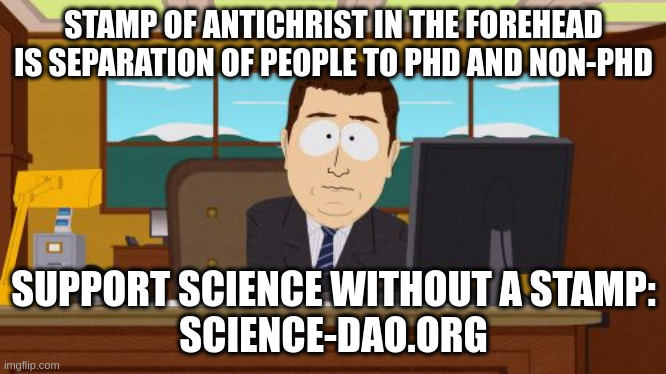
Science degrees and PhDs are designed by the devil to deprive people of scientific knowledge. A dire warning to those who follow the worldly, discriminatory way of doing science – you will go to the hell.
Here is (a little bit edited) my email reply to a person ######:
There is a very straightforward explanation, what are stamps on the forehead and on the right hand: PhD and hand-working occupations certificates.
Thus Apocalypse is very clear in saying that everybody who is on the side of PhDs will go to the hell.
Why are PhD blamed so badly? I think, it is because of me: I discovered “ordered semigroup actions” (OSA) and some related things. For silly reasons like too big size of the text, I didn’t (yet) succeeded to publish anything on this topic (except of a Russian publication, that does not count, because it requires knowledge of Russian to buy the file). OSA are as important as “groups” (discovered by Galois in 19 century); in other words, OSA is >1/2 of world economy. PhD unjustly (supported by the government) compete with publication of OSA, thus each PhD pushing world economy down. (OSA is especially important as a missing component: a missing component is more important than published components. For example, a cup of water costs a billion dollars in wilderness, because it is missing.) So, God is angry at PhDs.
You are on path to the hell. You chose a Catholic mark.
The Article About PhDs As a Way to Hell
On 07/06/2025 3:20, ### ### wrote:
Hello Victor,
I only interview people who have PhDs and/are currently earning a PhD. I also only choose papers or books that are discussed in academic literature. Lastly, I choose topics that are of interest to me and of interest to my viewers.
Creating a new religion doesn’t require rejecting the past but creatively reworking the religion of predecessors. Here’s my new religion Telosism, building upon Christianity (it seems no one before me has managed to truly rework Christianity, rather than just rejecting or slightly modifying it):
Jesus taught, “Whoever saves their soul in this world will lose it in eternal life, but whoever loses their soul for my sake and the gospel will save it.” Here’s the explanation: the soul in this world is the electrical activity of the brain, while the soul in eternity is the radio waves emitted by the brain (Russian scientists recently demonstrated that the brain does emit them) and living in the cosmos. Now, the hidden meaning of Jesus’ teaching becomes clear: he gave his disciples commandments that would provoke people’s anger, allowing them to receive compensation for that anger in God’s judgment. For example, a Christian is beaten on the head for the gospel and becomes a rapist maniac (my experience shows this can happen): they’ve lost their soul in this world, thus saving their soul for eternal life (i.e., receiving a new soul as compensation).
The catch is that once you understand what I’ve discovered, provoking people’s anger for compensation no longer works: if you keep doing it, you’re deliberately harming not only yourself but others too. This ends the effect of Jesus’ commandments—Christianity itself.
And I, for making this discovery, will be transformed into a great prophet—one of the two witnesses of the Apocalypse. I’ll first be made sinless, then taken to heaven, not in a fiery chariot, but in the coolest transport—a time machine—and I’ll become the archangel Gabriel, the ancestor of all gods and the father (through cloning) of Jesus.
What about the others? I discovered the operations of partially ordered semigroups, but the vile PhDs refused to publish it. Then God explained to me that the “mark on the forehead” in the Apocalypse is a PhD or academic degree. This means everyone siding with the PhDs will end up in hell.
Should Christians follow commandments or love? It looks like impossible to combine both, but “the mystery of the Gospel”, what Jesus hid from His disciples, explains it in a surprising way. How the philosophical quest of morality is resolved by Jesus.
This article is dangerous: If a non-saved person reads it, he/she loses ignorance needed to enter the Church and is destined to hell. I nevertheless publish it openly for the purpose of growth of Jesus, as the first verse of the Revelation of John can be translated “The revelation for Jesus Christ…”
Imagine a young Christian—perhaps someone like your son or daughter—sitting in a college classroom. A professor challenges their faith with sharp questions they can’t answer. Doubt creeps in, and without the tools to think critically, their beliefs start to unravel. This isn’t just a hypothetical; it’s happening every day. At After Gospel, we’re fighting to equip Christians with the philosophical skills they need to stand firm—but we can’t do it without you.
Without philosophy, Christians are defenseless in a world of tough questions and slick arguments. Picture a parent unable to explain why they believe to a curious child, or a student walking away from church after a debate they couldn’t counter. We’ve seen believers lose their footing, swept away by trendy ideas or paralyzed by doubt. This isn’t just a personal crisis—it’s a threat to the Church’s future.
To become a Christian, you must repent of sins. To do this, you need to understand what is sin and what is to repent. If you understand this, you are a philosopher.
A famous philosopher Immanuel Kant thought that for a thing to be in “good space” (he called it moral imperative), it should be a thing that would fit to be an universal law. Kantians believe that moral choices should be based on some (abstract) moral law.
Meanwhile the New Testament teaches to live not under a law: (Gal. 2:16) “knowing that a man is not justified by the works of the law but by faith in Jesus Christ, even we have believed in Christ Jesus, that we might be justified by faith in Christ and not by the works of the law; for by the works of the law no flesh shall be justified.” To live by no law means that no law (including a moral law) instructs you: You simply do good and it is not under a law. It means, whatever advanced (both legal or moral) law is, it is not enough to do good.
In more details: There are two kinds of morality: morality based on rules and morality based on outcome (if you know a third option, write to me, I don’t know such one). The morality based on rules has this kind of problem: In such a morality situations like this emerge: You followed all traffic rules but crushed a person, is that right? Crushing a person is an example of an outcome that may happen, even if all rules are followed. Or in a moral based on rules, it would be bad to kill Hitler, because it is, well, killing. This article explains the biblical philosophy on the two kinds of morality.
So, the morality of Kant and after him of most Christian preachers is based on rules. But I argue that love should be the main principle of morality.
So, back to the Bible: What is a sin? (Matthew 7:21) “Not everyone who says to me, ‘Lord, Lord,’ will enter the kingdom of heaven, but only the one who does the will of my Father who is in heaven.” We see from this that sin is to do contrary to God’s will. Obviously, God’s will is some standard of good: a comparison which things are better and which are worse. To enter the kingdom, need to do the same: choose good. So, in its broadest sense, a sin is just a choice of a thing that is worse than the perfect good choice (God’s will). If you think that God’s will is the same as His commandments, you fall in the same trap as these MPs who forbid prostitution: This leads only to it going illegal, without proper medical care, so inflating the number of people with STI. If you only follow rules, you may not have love.
(Jam. 4:17) “Therefore to him that knows to do good, and does it not, to him it is sin.” This means that God requires us to choose good always, every time we understand how to do it (otherwise, sin is to him, not to saving grace of Christ and the grace does not work). I think, one-time violation of this rule (without repentance) warrants hell. That’s because, when you refuse to do good, you refuse your prior asking God to make you doing good, that you asked from God when you converted (if you ever converted). In Christianity, there is no place at all for “freedom” to choose sin. Of course, we many times don’t know how to do good, in that case this verse does not apply. There are two kinds of sin: unintentional one (compatible with salvation) and willful one (not compatible with salvation!) That means an astonishing thing: If you even once deliberately choose not the best way to live, you are in danger of hell! This means that all your life need to be the “job” of doing good and nothing else: As a Jewish rabbi (Rabbi Nachman of Breslov) taught, when we sleep we by it serve God, because sleep gives us more power to do good.
You see, the concept of repentance is based on the concept of sin. A sin is any choice that is not the best. Above it’s shown that no willful sin is pardoned. When a new Christian converts, it means that he/she asks from God not to commit sins again. It can be properly asked, only if he wants not to sin, that is wants to always make the best choices. If a human wants and can, he/she necessarily does. It logically follows that a converted Christian commits no willful sins: If he can not to commit a sin, he/she doesn’t commit it, because he also wants (can+want=>does). No Christian even committed a willful sin. This means, that never a Christian did a choice that he/she does not consider the best one. For example, if a Christian buys something, he buys what is best not for him/her but the best for the service to God. (Service to God includes keeping yourself well-fed, but if you serve to God, you would want to well-feed other people, too, and want+can=>do.) If you did any willful sin, that is made not the best choice you know, e.g. in money, you need to convert again.
You may respond: Jesus said: (John 14:15) “If you love me, keep my commandments.” Thus (if we take this your supposed position) the morality of the New Testament is indeed based on rules. You mean that you wouldn’t kill Hitler, because killing is forbidden, don’t you? I just trolled you by the question in the previous sentence. Speaking seriously, in the Bible there are both morality based on rules and morality based on outcomes. And I am going to explain you their intricate interconnection in words of Jesus. So allow me first to speak first of morality based on outcomes:
If you love somebody, you will do him/her good even without any commandments. And you may try to follow all the commandments and not to do good to a person who you don’t love. The New Testament teaches that without love all efforts are vain. Love is an universal adherence to God’s will.
In fact, in the world the word “love” is often used in the reverse sense to its biblical meaning. For example, there is a movie A.I. Artificial Intelligence (or simply A.I.) is a 2001 American science fiction film directed by Steven Spielberg. Accordingly the plot of the movie, love of the robot is the inability to change the owner. Based on this logic, people say that they love their relatives (as one cannot change who are their relatives). But the Bible teaches: (1John 4:16) “And we have known and believed the love that God hath to us. God is love; and he that dwells in love dwells in God, and God in him.” To dwell in God means not to be limited to love to a limited set of loves ones, but to love all that in God. So, the love, as it described in that movie, would be true love only if it were directed to God (not to the owner of the robot). Do I speak my imaginations or is it confirmed by God’s word? (2Jn. 1:6) “And this is love, that we walk after his commandments.” Nothing about relatives here, while the devils tries to persuade us to love relatives and established friends.
Simply put, love is the desire that everybody would, if possible, become richer (not in money only). I know that from the words of Jesus: (Jn. 14:28) “You have heard Me say to you, ‘I am going away and coming back to you.’ If you loved Me, you would rejoice because I said, ‘I am going to the Father,’ for My Father is greater than I.” This explain what the word “love” (agape in Greek, not other words also translated “love”) means: it is to wish for someone to go to something greater than he has. Note this paragraph: I explained you in simple words what is agape.
There is a simple principle: If you want and can, then you do. If you want somebody to become richer, you are ready to pay him your money. Otherwise you either can’t (have an empty bank account) or don’t want (don’t love). Because love is a “want” and want+can=>do, love can’t be without deeds (unless you can’t). Love moves money from your purse to charity (“charity” is another meaning of the word agape).
God demands from us love and any sacrifice that is less than love is not accepted: (1 John 4:8) “He that loves not knows not God; for God is love.”
Who try to follow commandments but don’t love, are called Pharisees and hypocrites. That should be clear for every Christian.
The first solution, that I thought of, for commandments looking like being against love, is: consider commandments as a mere advice, not a command, or commands for the time and situation Jesus was preaching at, not for modern times. But this idea fails: The commandment to confess Jesus before sinners was kinda harmful since the beginning. So, we need to understand that commandments are indeed a command, not an advice.
But God gave commandments and this is important. Now, having the commandment “don’t kill”, would you kill a maniac who is going to kill ten people, unless you kill him? Different Christians answer differently on this question. What do I advice in this regard, to kill or not such a maniac? The short answer is “It depends.” The long answer follows below.
I will describe my personal moral dilemma that I had, when I was young. My mother was strongly opposed to Jesus commandments (for the stupid reason that she didn’t like His manner of speaking, especially “True, true, I say to you…”, challenging His right to speak in this manner.) Because of this, I was punished for my commitment to the Gospel by hits by my head of a big frying pan thing (and also by hunger). As the result I was going mad (temporarily). BTW, I will explain below how going mad from a hit to the head doesn’t contradict to the biblical concepts of soul and spirit, that, preachers say, our mind is located in. Going mad, I caused extreme harm. For example, after being driven mad, I raped somebody. For another example, I broke security against hackers in the entire Linux software industry by giving a deliberately (or, more exactly, “decided” by the frying pan) wrong advice to an engineer. I also lost the opportunity to become a math professor because of my attempt to follow Jesus. How much more good deeds I could do, if I were a professor!
If I didn’t follow the commandments (but would do, as was required by my mother, “Just believe, don’t follow commandments,”) there would be no this rape and this wrong advice due to which everybody and you lost security. There would be no such harm. If you think, you not an animal without mind, your mind should immediately raise the question: Why did Jesus give such commandments that may lead to harm? Jesus is perfect, so He knew it will produce such results. So, the harm produced by Jesus is deliberate. Why then did He make the deliberate choice to produce this harm?
I am not an alone person who did such a harm under Jesus’s influence. Consider every Christian who opposed homosexuality, lost the job for this and became a homeless, a person who spreads diseases. That’s extremes (big things), but in small things one would also lose, if holding tight the commandments.
I considered: Maybe, the commandments are mere advice rather than commands, or that commandments of Jesus were just for people of that time and his environment. I thought: Apparently, for example, the commandment “don’t commit adultery” was right only till invention of condom, wasn’t it? I would decide so, if not the special commandments that does not fall into this pattern (“was right in the past, but now it is outdated”), the commandment not to deny Jesus before sinners and the commandment not to be ashamed by Jesus. That commandment was causing harm in time of Jesus, too. It is not outdated, it is plainly wrong that Stephan has been killed. It is wrong now and it was the same way wrong in the time of Jesus.
Actually, trying to follow the commandments of Jesus and understand what purpose they are, I came to making choices that make me poorer, not because I wanted to be poor but because I didn’t find another criterion of what is sin, except that sin (such as theft) may make richer, therefore I leaned into the direction to be poor.
Stop reading here and try to find an explanation: Why did Jesus give commandments that are known to regularly cause harm? And this is a harm not only to the follower of Jesus but also to these who are around.
I will tell you the explanation. I spent literally tens of years thinking about this without an explanation, and am sure that the explanation, that I finally found, is the only possible explanation.
Jesus directed us to receive illegal harm from others in order for us to receive a compensation from God. So far, so good. But why did He make us to harm others?
Stop here and think:
I shot into the point, didn’t I? The meaning of previously seemingly illogical Christianity became clear: guilt on Jesus, suffer with Jesus, faith, patience, holy fools, lose the soul in this world for eternal life, the first are the last, etc. I “shot” precisely into the true meaning of Christianity.
Now it also becomes clear, why loving God sends unbelievers to the hell:
The hell is required for consistency of God’s judgment: If God rewards Christians for spoiling their souls, then for consistency of the court decisions somebody needs to be judged for this evil. Otherwise it would be that the court claimed that somebody needs to be rewarded in this exchange because a real evil happens, but nobody would be punished. This would make God a liar (both accepting and rejecting this exchange of evil and good in the legal process), what cannot be.
Here I will discuss idealism vs materialism as applied to human soul, not about existence of God (we know, that He exists).
Idealistic philosophers like Hegel believed that human is a “pure spirit”, a thinking “substance” separate from the matter. But science tells that humans think with the brain, what is easily proved by the fact our minds are legible to physical influences (hits by head, alcohol, LSD, to name a few). If we were pure spirits, accordingly Hegel, LSD would have no effect on our minds.
Interpreters of the Bible are easily leaned to “pure spirit” interpretation, because the Bible names something called soul and spirit, that are not parts of the brain but have their own minds. I will however give a materialistic explanation what is “the soul”, that agrees to both the Bible and the science:
The soul can be considered either as a backup copy (that God stores) of the brain or electromagnetic waves radiated by the brain. These waves go to the outer space and keep living in heavenly spirits. So, it becomes clear what Ephesians tell about us “sitting” in heavenly places (already now, not only after the death). So, in full accordance with the Bible, a human has a soul that is distinct from his/her brain, and has mind on its own.
We however can remain in the delusion of idealism, while our brains are not affected.
Interpretation of Matthew 25:31-46 (sheep and goats): The growth of Christ happened when we suffered with Him, because one suffering with Christ receive compensation for their suffering that grows Christ’s “riches”. If a nation leaves somebody without help, he cannot remain an idealist and begins to spread materialism that is incompatible with suffering with Christ. For this reason this nation “dies” as Christians. The least of brothers of Jesus mentioned in this passage was me, because I was very big with minus (I used magic of thoughts to provoke terrorism and finally a thermonuclear war, so I was the worst magician of all). I, the least of the brothers, suffered with no food and beating, that made my stupid idealistic philosophy incompatible with practice and impossible. Therefore, I turned to new philosophy that is the end of the Gospel, making finally unable who hears me to suffer with Christ. Jesus told about separating nations rather than people. Now there is one nation due to Internet and English. Do therefore all the big nation go to the eternal fire? So, one not feeding a hungry imposes a limit to growth of Christ, making Him relatively “hungry” by placing end on idealism.
On the other hand, “if a seed falling to the ground does not die, it remains alone. If it die, it brings much fruit”. This proverb is almost literal: If somebody does not die for the gospel (Seed symbolizes the Gospel.), he/she will live eternally without sex and children (“alone”), but who dies for the Gospel (accordingly my end of Gospel theology), he will become a god/elf/Nibirian, will have sex and septillions of descendants.
The problem is that Jesus did not address (kept silent about) the trolley problem for His followers: a Christian example of this problem would be: If a Christian physician denies Jesus before an evil regime, that kills everybody confessing Jesus, the physician will survive and heal dying 10 people, 5 of which would accept Jesus. We have +4 in confessing Jesus, if the physician denies. Should the physician deny Jesus? Personally I had a similar but much greater magnitude problem: I was a young mathematician (already that time) having an important formula, that would advance civilization by trillions of dollars, + future perspectives and I would die confessing Jesus, because my mother hated Jesus and was ready to kill me. Should I have denied Jesus before that mad woman to save life of millions of people, who would benefit from greater world GDP?
Jesus didn’t told us a way to deal with trolley problem, but simply made commandments that look like incompatible to a reasonable solution of trolley problem, to confuse us. Especially consider his commandment not to deny him in words and not to be ashamed of his words. This looks like not to have a reasonable explanation: We are told to play a game with words and to be murdered for winning a game. That looks like a nonsense: What in the world would become worse, if we’d lie that we are not Jesus followers? Why for a game that Jesus plays with us, us to be tortured and murdered?
So, we have a principle of a cross execution: I was strongly pulled in different directions by different moral indicators, like a person hanging on a cross is physically pulled in different directions what leads to suffering and death.
What is the solution of the trolley problem, that a Jesus’s follower should choose? The answer is unexpected: The best solution depends on whether you know why Jesus put certain moral orientations: If you don’t know why, you should choose following commandments (that physician would refuse to deny Christ); if you know why, you should choose following love, even if to do it you need to break commandments (that physician would deny Christ to save ten people from death).
Jesus calls himself an advocate lawyer in (Jn. 14:16) “And I will pray the Father, and he shall give you another Comforter, that he may abide with you for ever.” (He says that Holy Spirit is another advocate (“comforter” is also translated as an advocate), implying that Jesus is an advocate, too.) So, Jesus is a lawyer. He made us to be under illegal attack of others (“I send you like sheep among wolves.”), in order for God’s court to pay us a compensation. Jesus just wants us to receive a God’s compensation for crimes committed against us. But harming ourselves, we harm others (like that physician taking lives of 10 more people together with his own life). Therefore, if we know the purpose of Jesus to harm us, we must stop doing so, because this way we would intentionally harm others, what is not a good deed. God’s court will consider these who we harmed this way our slaves (because they depend on our adherence on Jesus’s commandments: we decide for them), and therefore the physician would receive God’s compensation not only for his own death, but also for death and any failures of his 10 slaves, having so his soul up to 11 times more valuable. (All failures of slaves are considered his own failures, so he gets compensation from God for these unsuccessful cases.)
Which kind of slaves is it about? (2Pet. 2:19) “for of whom a man is overcame by, of him is he a slave.” It is a very simple principle: anyone who is inferior of another in the Kingdom of Heaven, he/she follows all commands of the upper. If someone is better than you an inch, and you enter the Kingdom of Heaven, then you will follow all his/her commands. If you disagree, you don’t enter Kingdom of Heaven. Who are more efficient algorithms rule over less efficient algorithms.
So, before this revelation, when we slavishly followed Jesus’s commandments, our best solution of the trolley problem was to avoid violating a commandment of Jesus, even if violating it leads to a greater good.
What is our new position on the trolley problem? We just should maximize good, in any way of our acting, that we can. We can, for example, kill to save more lives. Before we would do this too, but then we would lack a greater compensation in God’s court.
Jesus said: “Let not my will be, but of the Father”. We were hardened in understanding what it means. It means simply “Father, stop me!” Jesus wanted to stop being kinda a corrupted lawyer. Jesus also said, “Let this cup be removed from me as soon as possible.” Through Paul, Jesus also delivered: (1Cor. 11:25) “This cup is New Testament in my blood.” Simple substitution gives: “Let New Testament in my blood be removed from me as soon as possible.” Jesus wants to end the New Testament and do it as quickly as possible. I no more take Eucharist (“New Testament in His blood”).
So, now love is our only guiding principle, no more commandments. (We should follow love, not because it is a commandment, but because it is our purpose.)
What does this means in practice? It means first and foremost to combat climate change, because it is one of the main problems of mankind.
I was unable to serve for climate, because of the commandment not to add to words of God and the commandment to love neighbor. This combinations of commandments was making me unable to add and love distant people too, what means foremost to do deeds to save them in climate emergency.
When we were followers of Jesus’s commandments, most of us were restricted by (1Tim. 5:8) “But if any provide not for his own, and specially for those of his own house, he hath denied the faith, and is worse than an infidel.” Now, we are free to follow love: If you need to kill your relatives by hunger in order to save climate, do it.

I have an important climate project. | Donate for it. I also have discovered ordered semigroup actions and some related things, what makes a big revolution in mathematics. Donate for building and spreading this knowledge that can raise world GDP like 2 times in 30 years.
If you didn’t donate, it means that even now, when you were freed from commandments that hindered you from acting about love, you don’t act on love. If you don’t donate, this simply means that you don’t have and never had love. Join me in love-driven action or miss the chance to change the world.
Is stealing to donate to a climate or science project good or bad? If you are caught, it is bad, because having been caught you cannot anymore serve for climate. But if you are uncaught, it is good.
There is a fairly tale about “Koschei the Immortal” who carefully “keeps his death”, that is protected himself from being killed. The state and banks do the reverse thing: keep me and others from having enough money to help them to live. If a bank would allow me to rob it, it would be good for the bank, because with money I would be able to publish my scientific research and help everybody including the bank that carefully keeps money against using them for good.

I also promised to explain what is soul (how then people go mad being hit by head, if the mind is located in the soul?) Soul can be understood either as warranty (that you’ll resurrect if die and will be healthy) for the body and the brain or as electromagnetic radiation of the brain. People don’t have any special “organ” to pray or read Bible, only the brain for all kinds of information (including the “spiritual” one). The soul (brain waves), however, keeps living in the outer space, both while a human is yet alive ((Eph. 2:6) “And hath raised us up together, and made us sit together in heavenly places in Christ Jesus”, where Christ means all the electromagnetic radiation in the world: (Mt. 5:14) “I am the light of the world,” in other words Christ is electricity – the force that penetrates all keeps everything together) and after the death for eternal life in the heavens.
If you are not ashamed being a saint, then you will be hit on the head for saying “shameful” religion, you will become crazy (for example, a rapist maniac or just a jerk). Thus, you have ruined your soul in this world (“soul in this world” is how Jesus called brain electricity), and therefore saved it for eternal life (that is saved radio waves emitted by your brain to cosmos), accordingly the principles of God’s court paying you a compensation. (John 12:25)
If the seed of the Gospel died for you, freeing place for love, then well-done! You will be taken to the heaven where God Himself lives and have there sex with persons of opposite sex taken to the heaven and bring septillions of descendants.
Donate for climate, science, and collaborative Bible-study software. If 10% of you donate $100, the projects will succeed.
Join the mission today.


The Apocalypse teaches that science degrees and PhD were designed by the devil to deprive people of scientific knowledge.
Victor Porton, no affiliation
Tsernichovskiy 12-5, Ashkelon, Israel
porton.victor@gmail.com
Conflict of interest. I personally benefit from donations to Salaries Science as the main (and currently the only) project’s developer.
Abstract. I claim that holding an academic degree without compensation to the society (such as from your “degreed” salary) is a “grave” sin warranting hell, based mainly on the “stamp on the forehead” in the Revelation of John. Academic degree is considered as a theft from biblical positions. Note that I am not against science itself, but against science degrees.
Keywords: Apocalypse, mark of the beast, stamp of the beast, academic degree, science degree, scientific degree, salvation, Christian libertarianism, Libertarian Christianity.
Like other Christians, I tried to guess what the “stamp on the forehead” from Rev. 13:16 may mean. Once I however was struck by what seems the most proper understanding: “forehead” here means what is the stamp is for: the mind located in forehead, that is the stamp is a certification of the mind, the higher education degree. And the other stamp in the same verse is on a hand, that is the stamp of hand-working skills that a human has.
This also explains some of the hidden sense after (Rev. 13:17) “And that no man might buy or sell, save he that had the mark, or the name of the beast, or the number of his name.” This simply means that people having no either higher education or finished high school (mark on the hand) will have no legal capacity.
Thus Apocalypse has a strong stance against scientific and other degrees, notably anti-PhD stance.
In the rest of this article I explain how this can be interpreted in context of the rest of the Bible, the modern status of the science, and author’s personal experiences.
Not far from the mainstream understanding of Rev. 13, I proclaim that a scientific degree is marking of people, splitting to “castes” with different rights. Christianity must be against such castes.
(1Jn. 2:2) “And he is the propitiation… for the sins of the whole world”. A possible translation is whole world, rather than entire world. For people for whom the world is divided into castes (not whole), there is no propitiation for the sins, that is they go to the hell.
Scientific degrees foster inequality: If somebody is in a position (for external to his mind occurrences such as living nearer to a university) to receive a scientific degree more easily than another one, who received the degree is in a dishonest economical advantage over another one. Such an advantage is considered a theft in context of Rev. 13. (1Cor. 6:10) “… thieves… shall [not] inherit the kingdom of God.” Theft warrants hell. Therefore a scientific degree (especially PhD) without proper measures warrants hell. This is in full accordance with (Rev. 14:9-11) “9 And the third angel followed them, saying with a loud voice, If any man worship the beast and his image, and receive his mark in his forehead, or in his hand, 10 The same shall drink of the wine of the wrath of God, which is poured out without mixture into the cup of his indignation; and he shall be tormented with fire and brimstone in the presence of the holy angels, and in the presence of the Lamb”.
Short note: They will be in presence of the Son (“the Lamb”) and holy angels, but forever will lose presence of the Father.
Another thing stolen by scientific degree holders is glory of a discovery: The author discovered an important mathematical object, ordered semigroup actions, but failed to publish it as a dissertation, because of holding no Bachelor or Masters degree necessary to put forth a claim for PhD. Thus inequality spreads not only to money, but to science itself, having some parts of science derailed and despised by this world. Because ordered semigroup actions (and ordered semicategory actions) are exceedingly important [1], it makes derailing of the most of future science, what is essentially theft of about $50 trillion. Everybody in academia participates in this theft (from yourself).
If you are told that you are evil, you can change, and you don’t, you are going to the hell: (He. 10:26-27) “For if we sin wilfully after that we have received the knowledge of the truth, there remaineth no more sacrifice for sins, But a certain fearful looking for of judgment and fiery indignation, which shall devour the adversaries.”
Can anything be done by a scientific degree holder to avoid the hell for himself/herself? If you were a thief but returned the money, you are no more a thief. So, your debt is to return the money to the system of science. How to do this? I know the one best way: Donate to the project Salaries Science [2], that is committed to finance science differently (and without checking degrees). By regular donations you return your debt you hold to science.
You may say: “But I donate to a church.” Isn’t returning the debt to another company than you hold a debt to a silly idea? Accordingly the teaching of the Bible, you must return the debt to one you have a debt to. So, if you hold a debt (by holding a scientific degree) to the system of science, and I know no other way to return the debt than to start financing Salaries Science project.
If you don’t, you are guaranteed to hell, because you sin wilfully.
The above may be perceived as similar to indulgence. But it is not, because the Catholic indulgence was assumed atonement of any kinds of sin for money, and this is for a special kind of sin, theft. Theft is readily atoned by returning the money to the object of the crime.
The stamp on the forehead is called the stamp of the beast, a symbol of stupidity. Moreover, (Rev. 14:10) “… The same shall drink of the wine of the wrath of God, which is poured out without mixture into the cup of his indignation…” Wine signifies stupidity, because a human who drank wine becomes stupid. This is especially true for wine poured out without mixture.
This means that the “brain” of this world, the academy is considered stupid by God. One example of such stupidity is missingness of ordered semigroup actions in scientific databases, due to degree separation process.
I was deprieved of a scientific degree because of my discrimination as a Protestant in Russia. I don’t want to tell here the details, because it is somehow related to a depth knowledge and may tempt Christians.
But, thanks God, I didn’t become this kind of a thief and gained experience undoubtfully showing that academia is evil and that the world needs Salaries Science project.
Holding scientific degree is a theft accordingly teachings of the Bible and is punished by the hell, if not properly atoned. The suggested way of atonement is to pay regular donations to Salaries Science project [2].
[1] Victor Porton. Why Algebraic Theory of General Topology is Super-Important. https://science.vporton.name/2022/09/09/why-algebraic-theory-of-general-topology-is-super-important/
[2] Salaries Science project. https://science-dao.org/salaries-science/
Use the following form to donate or go to monthly donation form.
The Apocalypse teaches that science degrees and PhD were designed by the devil to deprive people of scientific knowledge.
Official science competes with publication of ordered semigroup actions, which like water in desert are more important than everything other thanks to their missingness in scientific databases. Holders of scientific degrees are evil (“stamp in forehead”), therefore, if they do not support the “salaries science” https://bit.ly/3WJhti2 #science
If you are told that you are evil, you can change, and you don’t, you are going to the hell: He. 10:26-27. You should use your “degreed” salary for salaries science https://bit.ly/3WJhti2 or you are condemned for holding a scientific degree against God. #sin #hell
You can stay in the system, but you must be against the system. If you are for (your) scientific degree, it is a “seal on the forehead” from the Apocalypse and you are guaranteed #hell. Support science without degrees https://bit.ly/3WJhti2 – #Apocalypse
Life’s challenges often remind us of our limitations and our need for divine support. When facing trials, it’s easy to feel overwhelmed and to question our faith. Yet, it’s precisely in these moments that praising God becomes most meaningful and transformative.
Here are ten reasons why praising God in difficult times can be a source of strength and solace:
God remains a constant rock amidst life’s chaos. His promises are steadfast and true, providing us with security and reassurance that He is always faithful.
Praising God helps us focus on our blessings rather than our problems. Gratitude reduces stress and fosters a positive outlook, helping us navigate difficulties with resilience.
Worship draws us closer to God, offering comfort and strength. Like David and Paul in the Bible, we find emotional and spiritual support through praise, easing our burdens and fortifying our spirits.
Reflecting on God’s past acts of faithfulness can reassure us of His continued support. Biblical stories, like the Israelites’ deliverance from Egypt, serve as powerful reminders of God’s enduring faithfulness.
Praise builds resilience and instills hope, reinforcing our trust in God’s plan. It helps us maintain a hopeful outlook and persevere through life’s toughest battles.
Praise is a powerful tool in spiritual warfare. Biblical accounts, such as Jehoshaphat’s victory through worship, illustrate how praise can lead to triumph over challenges and adversities.
Worshiping with others strengthens our faith and provides mutual encouragement. Shared worship experiences build a support network, reminding us that we are not alone in our struggles.
Praising God acknowledges His control over every situation. Trusting in His plan and surrendering to His will brings peace and helps us see our struggles as part of a larger, divine picture.
Praise deepens our intimacy with God, fostering a closer relationship. Regular worship enhances our spiritual lives, making our bond with God stronger and more profound.
Worship transforms our hearts and minds, shifting our perspective and invigorating our faith. It helps us handle challenges with a renewed and resilient outlook, grounded in God’s love.

Incorporate praise into your daily life with practical steps such as singing worship songs, praying, reading scripture, and journaling gratitude. Regular worship, alone or with others, helps maintain a spirit of praise amidst trials.

In tough times, praise acts as a lifeline, redirecting our focus from despair to hope. Worship shifts our perspective, helping us connect with a deeper sense of peace and purpose. It reminds us of God’s enduring presence and unwavering love, offering stability and hope.
Praising God during difficult times offers stability, comfort, and resilience. By focusing on God’s unchanging nature and acknowledging His sovereignty, we deepen our relationship with Him and transform our outlook. Share your experiences of praising God during tough times. How has worship helped you overcome challenges? Leave a comment and let’s support each other through the power of praise.
Trusting God is crucial for a vibrant spiritual life. It involves developing a deep, enduring relationship with Him, built on faith and confidence in His plans. Yet, there are signs that we might not be fully trusting God, which can affect our spiritual well-being. Recognizing these signs is the first step towards fostering a stronger, more trusting relationship with God.
In this post, we’ll explore ten clear indicators of a lack of trust in God and offer practical steps to make positive changes. Let’s dive in.
Description: Worry and anxiety often signal a lack of trust in God. Persistent worry about finances or health can indicate that we are not fully relying on God’s promises for provision and protection.
How to Change: Combat worry through faith by praying regularly and meditating on scriptures that affirm God’s faithfulness. Philippians 4:6-7 encourages presenting our requests to God with thanksgiving, promising peace that surpasses understanding.

Description: Struggling to relinquish control often reflects a lack of trust in God’s sovereignty. If you find yourself meticulously planning every detail of your life, it might indicate fear that God’s plan won’t align with yours.
How to Change: Practice surrendering control through prayer and reflection. Proverbs 3:5-6 advises trusting in the Lord with all your heart and not leaning on your own understanding. Embracing this can help you trust in His guidance.
Description: A weakened prayer life may suggest a lack of trust in God’s guidance and support. If you’re not seeking God in prayer, it may reflect a belief that you can manage things on your own.
How to Change: Revitalize your prayer life by dedicating time each day for prayer and reflection. 1 Thessalonians 5:17 encourages us to pray continuously, reinforcing the importance of turning to God in all matters.
Description: Relying heavily on material possessions for security and happiness can signal a lack of trust in God’s provision. If accumulating wealth becomes a priority, it might replace your trust in God’s abundance.
How to Change: Focus on spiritual fulfillment rather than material wealth. Matthew 6:19-21 reminds us to store treasures in heaven, emphasizing the eternal value of spiritual over material wealth.

Description: Doubt undermines trust in God’s promises. Constant questioning of God’s plans or His ability to fulfill promises indicates wavering faith.
How to Change: Strengthen your faith by immersing yourself in scripture and prayer. Romans 10:17 states that faith comes by hearing the word of God, so regular Bible study and prayer can reinforce trust in His faithfulness.
Description: Fear of change can indicate a lack of confidence in God’s plan for your growth. Resistance to change often means not trusting in His plan for your development.
How to Change: Embrace change as an opportunity for spiritual growth. Jeremiah 29:11 reassures us that God has plans to prosper us and give us hope. Trusting in His guidance can help you navigate transitions.
Description: Ingratitude reflects a failure to recognize God’s blessings. When you don’t practice gratitude, you might overlook the ways God cares for you, weakening your trust in His goodness.
How to Change: Cultivate gratitude by daily reflecting on and giving thanks for God’s blessings. 1 Thessalonians 5:18 encourages giving thanks in all circumstances, which strengthens trust in God.
Description: Prioritizing human wisdom over divine guidance can indicate a lack of trust in God’s sovereignty. Valuing worldly advice more than scriptural truths shows a lack of faith in God’s wisdom.
How to Change: Align your beliefs with scripture by prioritizing God’s word. Proverbs 3:7 advises not to be wise in your own eyes but to fear the Lord. Seeking wisdom through the Bible can realign your trust.
Description: Resisting surrendering to God’s will shows reluctance to trust His plan. This resistance reveals a lack of confidence in His knowledge and intentions for your life.
How to Change: Embrace surrender by engaging in prayer and specific acts of surrender, such as writing down your worries and offering them to God. Romans 12:1-2 encourages offering ourselves as living sacrifices, reflecting trust in His plan.
Description: Neglecting to seek God during difficult times reveals a lack of trust in His comfort and provision. Turning to other sources for solutions can mean missing out on the peace and strength God offers.
How to Change: Make it a habit to seek God in all circumstances. Psalm 34:17 assures us that the Lord hears the righteous and delivers them from troubles. Regular prayer, scripture reading, and community support can help you turn to God first during challenges.
These ten signs can help identify areas where trust in God may be lacking. By implementing the practical steps provided, you can deepen your relationship with God and experience the peace and fulfillment that come from a strong faith in His promises. Reflect on these aspects in your own life, commit to growing in trust, and embrace the spiritual benefits that follow.
Pentecostalism is celebrated for its vibrant worship, miraculous healings, and influential leaders. In this blog, we spotlight the 10 famous Pentecostals whose remarkable stories and significant contributions have profoundly impacted the movement and Christianity. Explore their lives and discover how their faith has shaped communities globally.
Pentecostalism is a Christian movement emphasizing the direct experience of the Holy Spirit, including speaking in tongues, divine healing, and prophecy. It began in the early 20th century with the Azusa Street Revival in Los Angeles, led by William J. Seymour. This revival ignited a global movement known for its dynamic worship and evangelistic fervor. Today, Pentecostalism boasts over 600 million adherents worldwide, impacting communities through worship, outreach, and missions.
We selected these top 10 Pentecostals based on their significant contributions to the faith, societal impact, and lasting influence. Key factors include their roles in founding churches, pioneering ministries, and shaping media and culture.


These leaders share a deep commitment to their faith and the transformative power of the Holy Spirit. They used media creatively, from radio to television, to spread their message worldwide. Their ministries have impacted millions and helped shape the future of Pentecostalism.
New leaders continue to emerge, inspired by these trailblazers. Their legacy encourages future generations to innovate and expand the reach of Pentecostalism.
These Pentecostal figures have significantly shaped the faith’s landscape. Explore more about Pentecostalism and its influential leaders to understand their enduring legacy. Share your thoughts and join the discussion on their impact.